
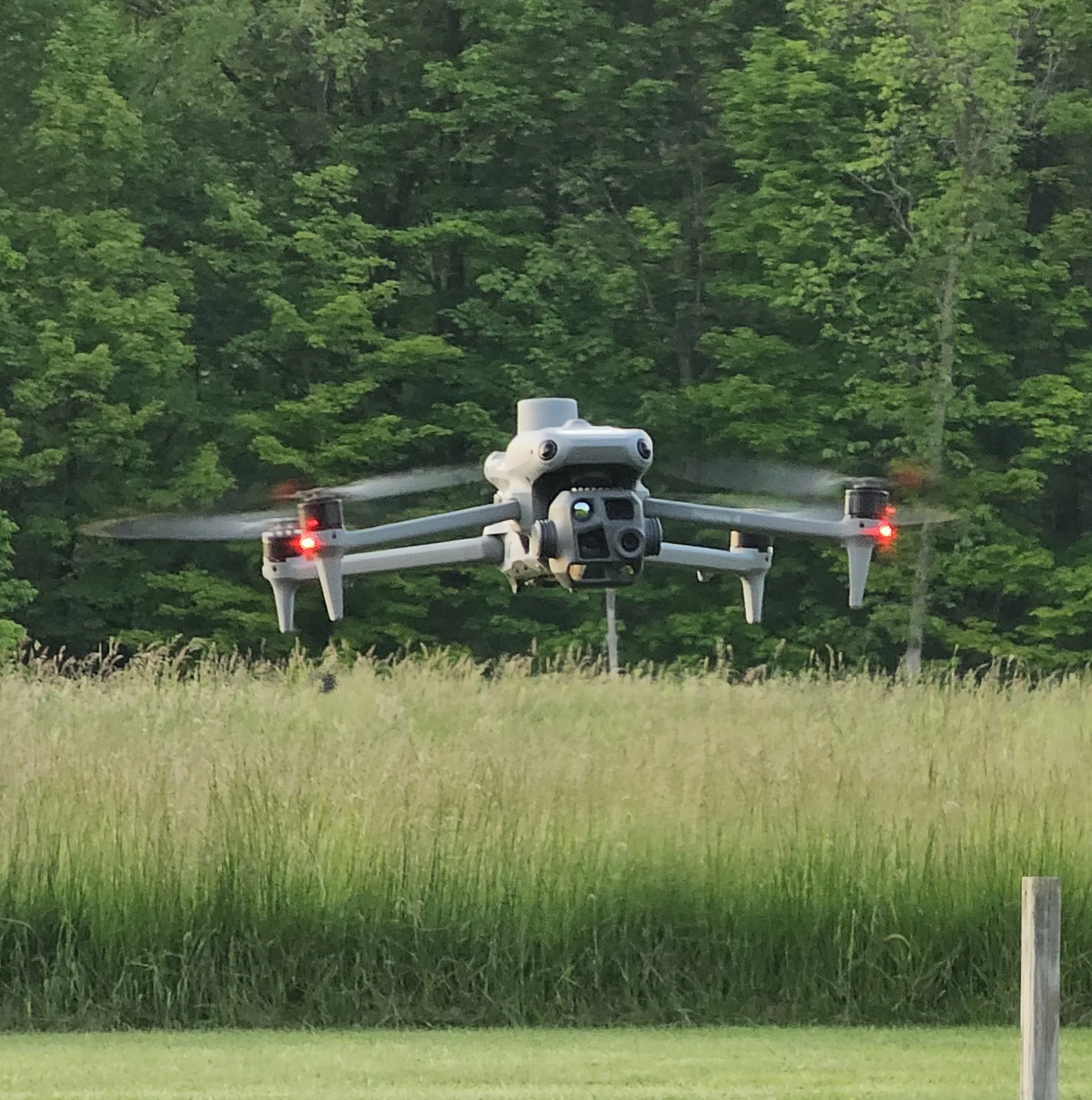
The drone community, first responders, search and rescue (SAR) teams, farmers, and small business owners are facing an urgent regulatory hurdle. The Federal Communications Commission (FCC) has proposed a rule under Docket 26-189 that threatens to reclassify standard, commercial drone equipment as "military-grade" technology and retroactively ban foreign-made drones and critical components.
What Is at Stake?
This broad rule targets essential tools used daily across public safety, agriculture, and local operations:
- Thermal Imaging Payloads: Used to locate missing pets, search for lost hikers at night, and assist firefighters.
- Agricultural Spray Drones: Essential for precision farming and sustainable crop management.
- LiDAR Obstacle Avoidance: A vital safety feature preventing crashes into trees, power lines, and infrastructure.
- Automated Docking Systems: Critical for rapid emergency response and utility line inspections.
- Swarming Capabilities: The core technology behind community drone light shows.
If implemented, approved domestic alternatives—where they even exist—cost many times more than existing equipment. For many essential applications, no domestic alternative exists at all. Without affordable gear, service providers like ours will be forced to drastically increase prices or eliminate these critical services altogether.
Watch the Expert Breakdown
To understand the full impact of Docket 26-189, watch this thorough breakdown by our friend Vic Moss of the Drone Service Providers Alliance: Watch DSPA's Analysis on YouTube.
How to File Your Comment Before Sept. 2
Public comments are open until September 2. Taking two minutes to speak up can protect these services for your community:
- Go to the FCC ECFS Express Portal.
- Enter 26-189 in the "Proceeding(s)" box.
- Share your story—whether you are an operator, first responder, farmer, or pet owner who has benefited from drone SAR.
Our Official Submission
You can download a PDF of our statement here, or read on. However, it is very important that if you are submitting your own comments, that you write your own statement, in your own words, explaining how this proposed rule will impact you, your business, your farm, your livelihood, your family, or your community. Do NOT Copy/Paste our or someone else's filing!
I. INTRODUCTION AND STATEMENT OF INTEREST
Northern Shore Technologies LLC, doing business as Strategic Air Captures, respectfully submits these comments in response to the Federal Communications Commission’s (FCC) Public Notice in PS Docket No. 26-189.
My name is Jason J. Rister. I am the owner and chief UAS pilot for Northern Shore Technologies LLC dba Strategic Air Captures, a small commercial drone service provider based in Cortland, Ohio. We provide critical civilian and commercial services to our local community and regional businesses, including thermal and visual roof and infrastructure inspections, insurance damage assessment, high-precision roof measuring and assessments for roofing contractors, thermal search and rescue assistance for missing humans, pets, and livestock, thermal deer recovery and wildlife population surveys aiding in wildlife conservation and management, and high-definition photography/videography utilizing drones with advanced obstacle avoidance sensors.
Small commercial operators like myself are the backbone of the civilian drone ecosystem. The FCC's proposed expansion to retroactively prohibit the importation and marketing of previously authorized UAS and critical components under the guise of declaring common commercial features "military-grade" represents an existential threat to my business, my investments, and the entire American commercial drone service sector.
To illustrate the immediate financial stake, our current operating fleet consists of the following equipment purchased to serve our clients:
- DJI Matrice 4T - Thermal & Optical imaging, laser range finding/measurement, RTK, etc
- DJI Air 3, DJI Neo, Potensic Atom 2 - Optical imaging of different sizes and capabilities, with obstacle avoidance technology.
Our total capital outlay thus far for these essential tools exceeds $13,300.00, heavily financed by small business credit lines, with interest and commercial insurance costs adding to this investment. Furthermore, the recent executive order imposing an immediate 100% tariff on the products targeted in this docket effectively doubles our replacement and maintenance costs overnight.
While the Commission claims that existing operators may continue using equipment they already possess, banning future importation, spare parts, battery replacements, and critical firmware updates, compounded by crippling tariffs, effectively puts a ticking clock on our ability to stay in business.
II. RESPONSES TO SPECIFIC QUESTIONS POSED BY THE COMMISSION
1. Scope and Definition of "Military-Grade" UAS and Critical Components
A. The Commission’s Proposed Definition is Severely Over-Inclusive
The Commission’s definition treats ordinary, dual-use commercial sensors, such as thermal imaging cameras, LiDAR rangefinders, docking stations, agricultural distribution systems, and LiDAR-based obstacle avoidance, as inherently "military-grade."
This classification relies on a fundamental logical fallacy: claiming that because a technology could be utilized on a battlefield, its presence on a civilian aircraft transforms it into a military weapon. By this flawed logic, household pressure cookers, tragically modified by terrorists in the Boston Marathon bombing, or standard four-wheel-drive pickup trucks modified in global conflicts would be classified as "military-grade" equipment and banned from public commerce.
In our daily operations:
- Thermal imaging allows us to detect heat loss in residential and commercial structures, find failing electrical connections on power lines or failing panels in solar arrays, assist first responders to locate lost persons, locate distressed livestock, or recover downed deer and conduct wildlife population surveys for local hunters and wildlife conservation efforts.
- Laser & LiDAR sensors enable roof measurements for local roofing contractors, preventing workers from climbing hazardous slopes, and provide real-time 360-degree obstacle avoidance that keeps our aircraft safely separated from power lines, trees, and structures.
None of these capabilities make an aircraft "military-grade." We urge the Commission to abandon feature-based blanket bans and adopt a true risk-based definition tied strictly to military-spec hardware design, specialized kinetic payload delivery systems, or verifiable data security vulnerabilities.
2. Assessment of National Security Risks
A. Commercial Operations Do Not Pose Acute National Security Risks
A commercial thermal camera or LiDAR sensor mounted on a commercial quadcopter does not inherently create a national security threat. Security risks stem from data handling and operator intent, not the physical presence of an optical or infrared sensor.
Commercial Part 107 operators utilize robust internal security controls. In our operations at Strategic Air Captures:
- Flight logs and payload data are stored locally on SD cards during flight. Log data is uploaded after flight to US-based log management software for processing and backup.
- Operations are routinely conducted entirely offline without active internet connections to external clouds.
- Aircraft are operated under strict operational security practices tailored to customer privacy requirements.
Furthermore, remote pilots operating under FAA Part 107 undergo rigorous federal background checks and vetting by the Transportation Security Administration (TSA). Treating certified, background-checked American small business owners as security threats simply because their equipment utilizes thermal or LiDAR technology is entirely unfounded.
B. US-made Products are not Immune from Intentional Misuse or Data Security Issues.
The assumption that U.S.-made aircraft, hardware sensors, or systems are inherently more secure or more resistant to misuse, simply because they are “Made in America” is logically flawed. An American-made hammer in the hands of an assailant is just as deadly, just as much of a threat, as one made in China or Pakistan.
Furthermore, software vulnerabilities, such as weak encryption, insecure firmware, or data exfiltration risks, are fundamentally issues of software architecture and operational implementation, not country of origin. U.S.-manufactured equipment is just as susceptible to hacking, unauthorized access, or intentional misuse as any other device if it lacks rigorous code auditing, secure update protocols, and robust data handling standards.
Relying on an origin-based definition of safety is a fundamentally flawed approach; true national security in the UAS ecosystem demands a focus on verifiable security standards and transparency across the supply chain, rather than a false sense of security predicated solely on manufacturing location.
3. Economic and Supply Chain Impacts
A. The Economic Impact on Small Entities Will Be Catastrophic
The Commission’s assertion that the impact will be "minor" severely underestimates the operational realities of commercial aviation. A drone fleet is not a static asset; it requires ongoing maintenance, replacement batteries (which have finite charge cycles), motor refurbishments, and repair parts.
If the FCC halts the importation and marketing of these aircraft and their critical components:
- Service Line Destruction: Strategic Air Captures will be forced to eliminate core service offerings, including thermal roof inspections, infrared utility audits, search and rescue support, thermal deer recovery and wildlife population surveys, and low-altitude visual mapping.
- Battery Degradation & De Facto Grounding: Commercial lithium flight batteries degrade significantly after 150 to 200 charge cycles, representing roughly 12 to 18 months of routine commercial use. Banning replacement battery importation acts as a de facto immediate shutdown of existing fleets, rendering legally acquired equipment completely useless long before its mechanical end-of-life.
- Loss of Capital Investments & Insolvency: Forcing small businesses to write off debt-financed assets (such as our $13,300+ initial investment) while remaining liable for financing payments creates severe financial distress and potential insolvency for small commercial operators under the Regulatory Flexibility Act (RFA).
- Distortion of Risk-to-Reward Ratio for Low-Margin Services: As hardware prices skyrocket and replacement aircraft become hyper-scarce or cost $15,000 - $21,000 , operators become deeply hesitant to perform low-cost, low-margin jobs. Risking a $20,000 irreplaceable asset on a $200 residential roof measurement or a low-cost missing pet recovery creates an unsustainable risk-to-reward dynamic. Small operators simply cannot afford to risk high-value equipment for low-return civilian jobs, pricing everyday homeowners, local contractors, and small community clients entirely out of the market.
- Aviation Safety Hazards: Small businesses being forced to stretch and extract every last drop of useful life out of UAS aircraft and their wearing components for lack of certified, inexpensive, accessible first-party replacements such as batteries, propellers, motors, etc. presents added safety risk to other manned and unmanned aircraft operating in the National Airspace System, as well as to persons and property on the ground.
B. Viable, Cost-Effective Domestic Alternatives Do Not Exist
"Available" does not mean "equivalent," "functional," or "cost-effective."
For our primary enterprise platform, the DJI Matrice 4T, domestic manufacturers frequently point to platforms like the Skydio X10 as a replacement. However, the Skydio X10 is fundamentally incapable of serving as an acceptable alternative due to severe technical, operational, and financial deficiencies:
- Technical & Hardware Deficiencies: The platform suffers from shorter battery flight times and shorter overall battery lifespans, significantly inferior optical and thermal zoom performance required to maintain safe standoff distances during utility, structure, and roof inspections (minimizing collision risks with power lines, towers, and guy wires while operating within standard FAA altitude limits), and lacks seamless, integrated Real-Time Kinematic (RTK) positioning needed for precise spatial mapping and 3D structural assessments without costly external modifications.
- Exorbitant Costs & Subscription Lock-in: A comparable Skydio X10 thermal setup costs between $15,000.00 and $21,000.00+ upfront, more than double the price of the Matrice 4T, and requires mandatory, recurring annual software subscription fees just to operate essential functions, severely eroding small business profit margins.
More critically, in the consumer, prosumer, and sub-$5,000 commercial space, focused on lightweight, highly portable, photography and videography aircraft equipped with advanced obstacle-avoidance sensors (represented by platforms like our DJI Air 3, DJI Neo, and Potensic Atom 2), there are zero American-made alternatives. No U.S. manufacturer produces an equivalent lightweight, highly portable, obstacle-avoiding aircraft anywhere near the $300 to $5,000 price range.
C. Compliance and Ecosystem Transition Costs Will Increase Exponentially
Transitioning to domestic platforms involves far more than purchasing an airframe. It requires replacing complete ecosystems:
- Discarding dedicated battery chargers, controllers, and proprietary payloads.
- Paying for pilot retraining and standard operating procedure (SOP) revisions.
- Loss of operational revenue during downtime.
- Managing higher insurance valuations and software subscription pricing models.
D. Supposed Domestic Manufacturing Benefits Cannot Bridge Immediate Needs
While supporting U.S. manufacturing is a laudable goal, the Commission's rhetoric regarding recent domestic investment ignores a critical market reality: virtually all recent capital investment and domestic manufacturing expansion in the U.S. drone industry has been concentrated exclusively in the military, defense, law enforcement, and large-enterprise government sectors.
Far from filling the void for small commercial operators, key American manufacturers have explicitly abandoned and discontinued their previous product offerings for the consumer, prosumer, and small business markets in order to pivot entirely toward lucrative, high-margin defense and law enforcement contracts. Restricting accessible commercial tools today will not magically induce domestic manufacturers to serve small civilian businesses when their corporate strategies are explicitly oriented toward government and military buyers.
Future domestic manufacturing capacity in high-end defense sectors cannot bridge today’s immediate equipment and cost gap for civilian operators. Punishing American service providers who rely on accessible tools destroys the user base needed to sustain any future domestic drone economy.
E. Failure to Spur Domestic Production & Innovation
Artificially removing market competition and imposing tariffs to drive up prices, particularly on products essential to consumers and small businesses, has demonstrably failed to spur genuine investment, innovation, or increased domestic production.
When competition is artificially restricted, existing U.S. manufacturers are insulated from market pressures, losing the critical incentive to develop and sell superior products. Instead of fostering a more robust domestic industry, this approach merely creates scarcity, allowing these manufacturers to inflate profit margins while continuing to market and sell sub-par equipment.
Without the discipline of a competitive marketplace, the industry stagnates, leaving small business operators to shoulder the costs of diminished choice and inferior technology.
4. Public Interest Analysis
A. Public Safety, Agricultural Efficiency, and Wildlife Benefits Outweigh Generalized Security Concerns
The proposed restrictions sacrifice clear, tangible public safety and economic benefits for speculative security concerns.
- Search & Rescue, Fire Suppression, and First Responder Support (Human Life Protection): Thermal-equipped UAS serve as indispensable force multipliers for emergency services and small commercial operators assisting local law enforcement, fire departments, and EMA’s. In low-visibility, nighttime, or dense woodland conditions, thermal imaging allows operators to rapidly locate missing children, disoriented elderly dementia patients, lost hikers, distressed livestock, and missing pets. During structure fires, thermal sensors allow firefighters to peer through dense smoke to identify hot spots, track fire progression, and locate trapped occupants. Similarly, in forestry management and wildland firefighting, thermal UAS provide critical early detection of wildfire origins, track rapidly moving perimeter lines, and pinpoint concealed ground hot spots to prevent dangerous reignitions. In time-sensitive search and emergency operations, thermal UAS reduce critical response windows from hours or days to mere minutes, directly saving human lives.
- Occupational Safety and Industrial Hazard Mitigation: According to OSHA, falls from heights remain a leading cause of workplace fatalities and severe injuries across the construction and maintenance sectors. Utilizing thermal and LiDAR-equipped UAS to conduct roof measuring, structural health assessments, high-voltage utility inspections, and cell tower audits keeps human workers off hazardous ladders, bucket trucks, and temporary scaffolding. By transitioning elevated risk tasks to uncrewed aerial platforms, commercial operators directly prevent workplace falls, injuries, and fatalities.
- Aviation & Ground Safety via LiDAR Obstacle Avoidance: Sensor-based collision avoidance, specifically LiDAR rangefinding and optical sensing, is a primary flight safety feature, not a military weapon. Real-time 360-degree spatial sensing enables aircraft to automatically identify and avoid thin power lines, guy wires, tree branches, and structural hazards that are otherwise difficult or impossible for a ground pilot to spot on a monitor screen. Restricting these advanced safety sensors directly increases the probability of mid-air strikes and loss of signal, escalating the risk of falling aircraft causing physical damage to property or personal injury to people on the ground.
- Wildlife Conservation & Management: Thermal-equipped UAS provide essential deer recovery and wildlife population survey services. This not only assists local hunters but directly contributes to broader wildlife conservation and management efforts by ensuring ethical harvesting and accurate population tracking.
- Agricultural Safety & Efficiency: The FCC's proposal targets UAS capable of dispensing "economic poison" under FAA Part 137 (agricultural spray drones). Agricultural drones significantly increase farming safety compared to manned crop-duster airplanes, which carry high fatality risks for pilots. Spray drones apply fertilizers and crop protection products with pinpoint accuracy, drastically reducing chemical runoff, fuel consumption, and operational costs.
Wiping out immense public safety benefits based on generalized security fears is contrary to the public interest.
5. Implementation Timeline and Logistics
A. The Proposed 180-Day Transition Window is Unrealistic and Destructive
A 180-day window is wholly insufficient. U.S. drone manufacturers currently lack the supply chain capacity, manufacturing throughput, and distribution channels to fulfill nationwide commercial demand. Transitioning an entire industry within six months would lead to severe hardware shortages, price gouging, and grounded fleets across the country.
Furthermore, because commercial flight batteries degrade within 12–18 months, prohibiting battery imports under a 180-day timeline will ground legally acquired aircraft long before their operational lifespan ends, effectively imposing an uncompensated phaseout.
III. LEGAL, JURISDICTIONAL, AND CONSTITUTIONAL CONCERNS
A. Absence of Historical Domestic Threat and Unfounded Imagining of the Homeland as a Battlefield
The Commission’s premise rests entirely on speculative, worst-case threat modeling that treats everyday commercial technologies as active munitions. However, empirical reality directly contradicts this fearful framing.
Commercial thermal imaging sensors, LiDAR rangefinders, and agricultural spraying UAS have been widely available and operating across the United States for over a decade, logging millions of flight hours in civilian airspace. To date, there has not been a single recorded instance of a civilian thermal, LiDAR, or agricultural spray drone being deployed in an act of war, terrorism, or violent crime within the United States.
Imagining the American homeland as an active battlefield to justify banning peaceful, commercial tools represents an unwarranted leap in regulatory policy. Regulating civilian trade and public safety equipment based on warzone paranoia rather than domestic reality sets a dangerous precedent, punishing law-abiding American business owners for hypothetical scenarios that have no basis in historical fact.
B. Presumption of Criminality Against American Citizens
The FCC’s rationale rests on the premise that drones equipped with basic sensors are inherently dangerous weapons that could be deployed offensively against the homeland.
This logic paints law-abiding American citizens as potential threats to national security. Actual people must transport, charge, maintain, and fly these aircraft. Actual certified Part 107 pilots, who have passed federal TSA background checks, are the individuals operating them. "Weaponizing" or "militarizing" any civilian drone for an offensive act against persons or property is already a serious federal crime. Preemptively banning the commercial tools of law-abiding citizens under the assumption that they might commit a crime treats the American public as enemies of the state without cause.
C. Fifth Amendment Unconstitutional "Taking"
Depriving business owners of the practical utility, economic value, and maintenance capability of their lawfully acquired assets constitutes an unconstitutional "taking" under the Fifth Amendment of the U.S. Constitution.
By banning the future importation of replacement parts, flight batteries, and required software updates, the FCC renders thousands of dollars of private commercial property useless, effectively taking away our livelihood and future revenue without just compensation.
D. Second Amendment Parallels and Protections
The Commission’s attempt to categorize these aircraft as "military-grade" based solely on the presence of completely passive features (such as thermal imaging or LiDAR) closely parallels the flawed rhetorical tactics frequently used to argue against the private ownership of firearms. By labeling dual-use technology as "weapons of war" or "military-grade" simply because it possesses features that could theoretically be used by the military, the FCC is establishing a dangerous regulatory precedent.
Furthermore, if the executive branch insists on legally defining these civilian commercial drones as "military equipment," it must recognize the logical constitutional conclusion of that classification. Under the original purpose and historical understanding of the Second Amendment, the civilian ownership of military equipment is inherently Constitutionally protected. The government cannot arbitrarily reclassify a commercial tool as a "military weapon" to justify banning it, without simultaneously triggering the strict constitutional protections afforded to the arms of the American citizenry.
IV. CONCLUSION
While I absolutely support and promote domestic production, a strong domestic supply chain, and the general economic welfare of the domestic UAS industry, the proposed rules will NOT genuinely advance the cause of “American drone dominance”. It will have a continued detrimental effect, destroying small businesses like mine, and eliminating the customer-base needed to make new and continued growth in the UAS sector possible.
The proposed rules in PS Docket No. 26-189 will not make the nation safer; they will simply ground American small businesses, endanger workers who must return to dangerous manual tasks, cripple modern agricultural efficiency, and impose severe financial hardship on certified commercial pilots.
Northern Shore Technologies LLC dba Strategic Air Captures respectfully requests that the Commission:
- Reject the broad "military-grade" classification for standard commercial features such as thermal sensors, LiDAR, docking stations, and agricultural spray systems.
- Allow the continued importation of critical maintenance parts, replacement batteries, and security firmware updates for all previously authorized equipment to allow American small businesses to continue to grow and thrive as domestic UAS production and competition develops.
- Implement a rigorous, independent security verification framework for existing equipment in lieu of blanket retroactive bans. By conducting random teardowns and objective hardware/software audits of off-the-shelf units, the Commission can establish quantifiable security benchmarks, ensuring compliance is grounded in empirical evidence rather than subjective classification.
Economic security for small businesses is a part of national security, too.
Don’t destroy our businesses, livelihoods, and families' security in a short-sighted attempt to fix a problem that doesn’t exist. Don’t destroy the very customer base and market that emerging and future American drone makers will need. Don’t sacrifice the dream of enduring “American Drone Dominance” over protecting the short-term profits or gains of a select few defense contractors.
Respectfully submitted,
Jason J. Rister
Owner & Chief UAS Pilot
Northern Shore Technologies LLC
dba Strategic Air Captures
Cortland, Ohio
https://strategicaircaptures.com